
Lately, I have felt more drawn to heritage design than ever. Whether it be in clothing or in interior design, the fascination with 'hand-made' is a rising phenomenon.
In an age when machines can now write, design, and even "imagine," the craftsmanship of human-made items is growing in appeal. Tech is now capable of producing images that look hand-drawn, essays that sound like you wrote them, and interiors that suggest a curated, lived-in charm. Yet amid this efficiency, an unease is growing. There is a growing demand for products made with authenticity, texture, and care.
But this isn't the first time we have seen this revolt against industrialisation. William Morris was grappling with this principle in the 19th century, though his concern was the factory assembly line rather than code.
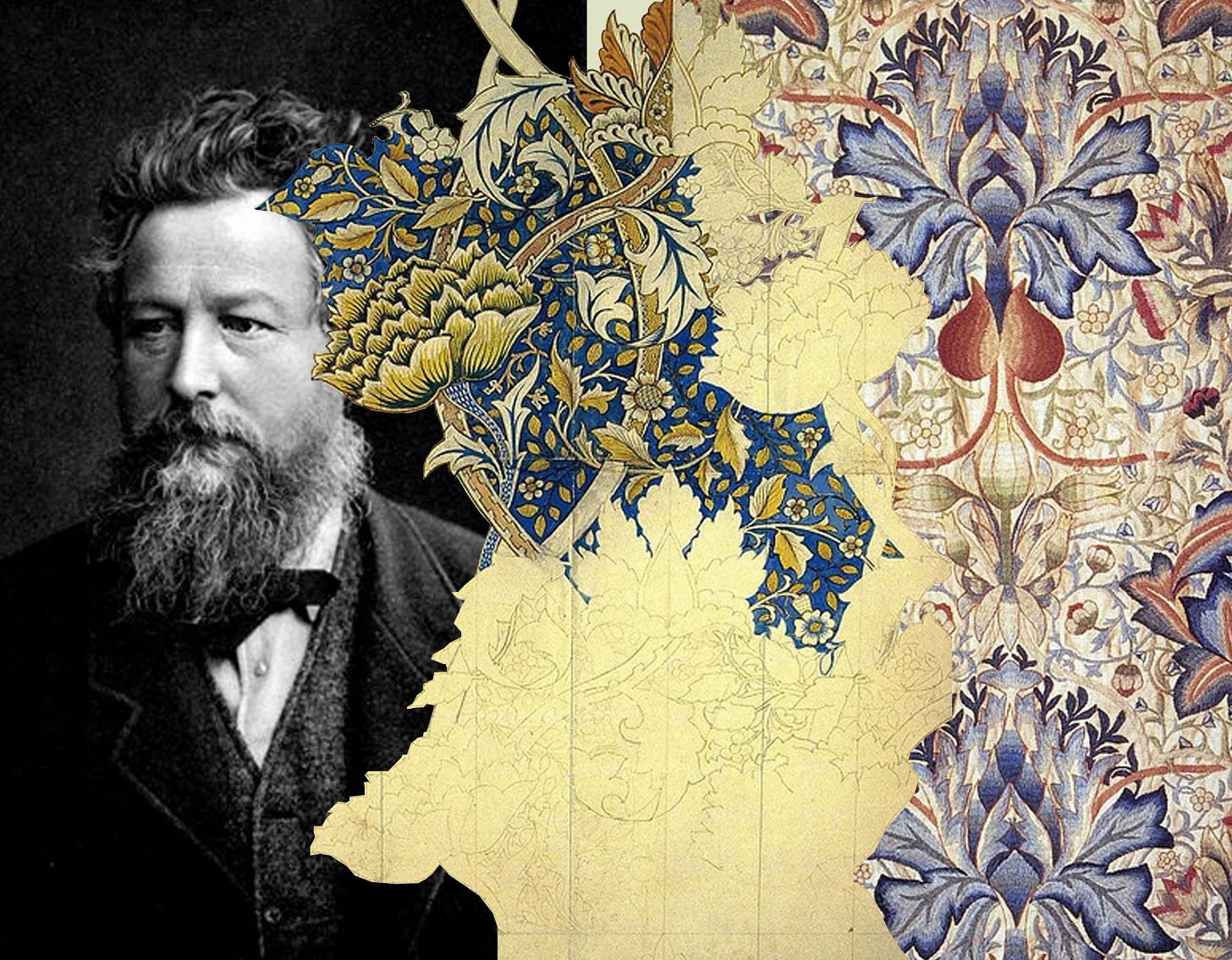
Image: William Morris and his designs courtesy of martineclaessens.com
The Original Radical
Morris was born in 1834 into a Victorian Britain transformed by industrial progress. After studying at Oxford, he joined a circle of artists and dreamers, including Edward Burne-Jones and Dante Gabriel Rossetti, who believed that art should do more than decorate life; it should define it. In 1861, he co-founded Morris, Marshall, Faulkner & Co., producing wallpapers, textiles, and furniture that rejected the soulless uniformity of machine-made goods.
His philosophy was simple but transformative:
"Have nothing in your houses that you do not know to be useful, or believe to be beautiful."
He believed that the mechanics of labour were stripping both workers and buyers of joy. His answer wasn't to reject progress entirely, but to insist that making should remain rooted in skill and intention.
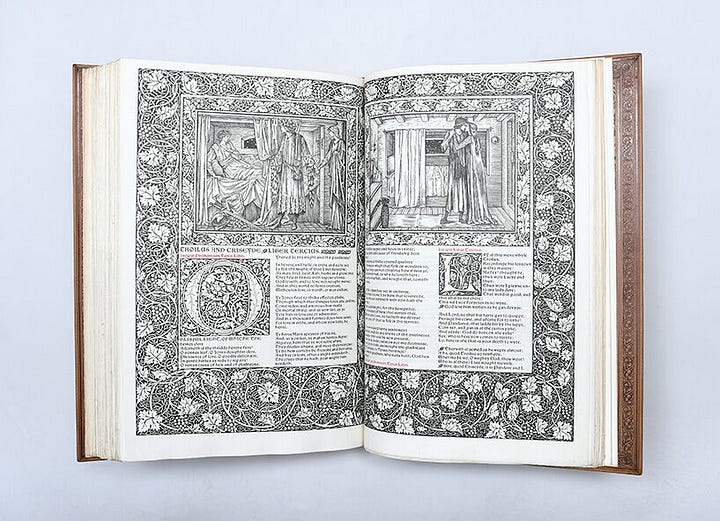
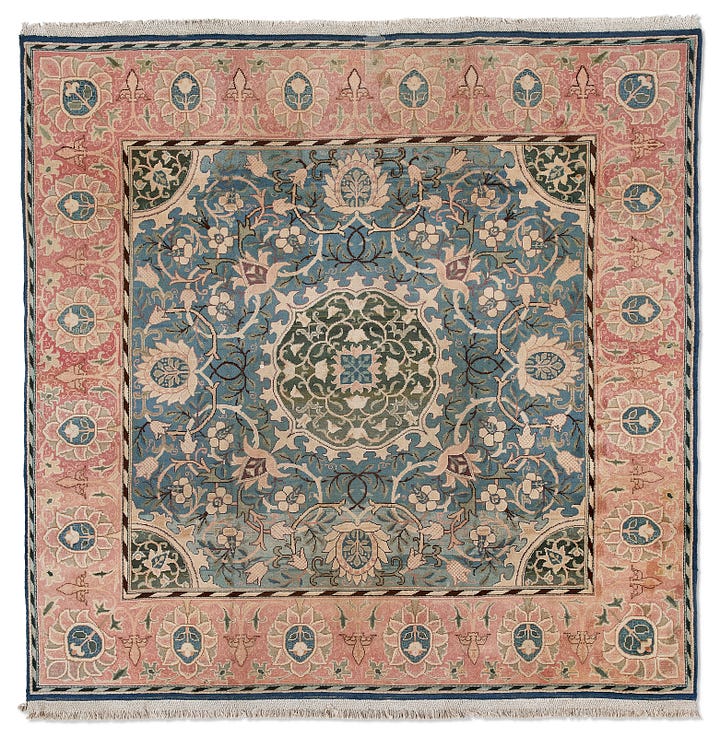
A Kelmscott Chaucer retailing for £175K and a 'Hammersmith' Rug sold at Christies for 126K USD
The Market for William Morris pieces
Today, collectors pursue Morris's legacy across many media, and as a dealer, I'm seeing the "emotional gravity" of these pieces translate into significant market value. While his designs are reproduced endlessly on the high street, the "first editions" are achieving record prices at auction houses like Lyon & Turnbull and Bonhams.
- The Kelmscott Press: Morris's hand-set books are the holy grails of the book arts. A single leaf from the Kelmscott Chaucer (1896) can now fetch several hundred pounds, while complete, well-preserved copies of his major works regularly command between £40,000 and £60,000.
- The "Hammersmith" Rugs: The hand-knotted pile carpets produced at his Hammersmith workshop are the pinnacle of Morris textile art. Recently, pieces have achieved between £20,000 and £30,000 at auction, with rare runners and smaller mats consistently exceeding their estimates.
- The Human Stitch: We are seeing a surge in demand for original embroideries, particularly those worked by May Morris or the skilled women of "The Firm." Small framed panels of "Olive and Rose" or "Vine and Acanthus" recently sold at Lyon & Turnbull for over £1,100, indicating that collectors are seeking a specific, imperfect human touch.
The call of craftsmanship
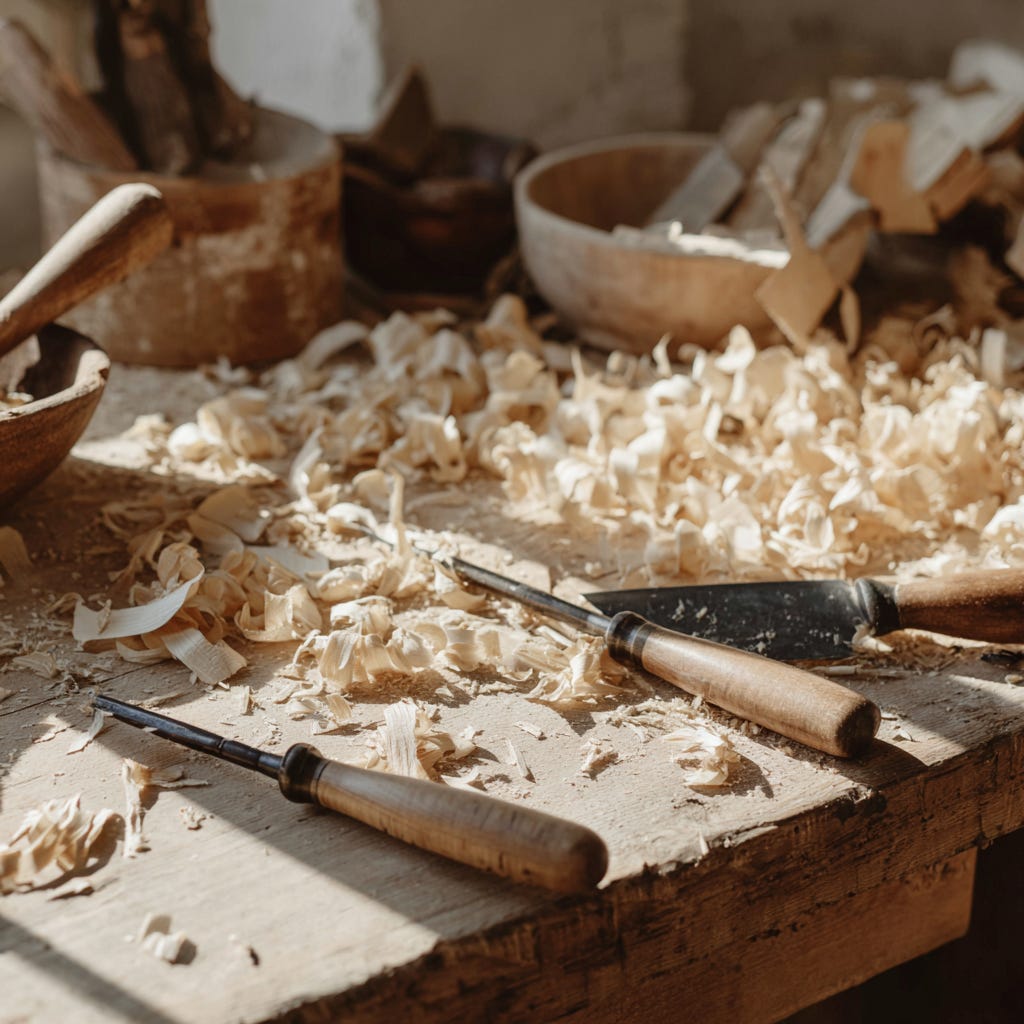
The values behind these designs have come back into sharp focus. In a digital world where everything can be reproduced, collectors are rediscovering the power of the authentic piece and the brushstroke you can see, as well as the stitch that isn't perfectly aligned.
The rise of AI art and automated design echoes the industrial order that once inspired Morris to carve out his own handcrafted counter world. Far from being a nostalgic retreat, his response feels like a guidepost. It reminds us that creativity, at its best, isn't about speed; it's about presence.
Perhaps that is why collecting Morris feels so relevant in 2026. These pieces are physical arguments for slowness and patience. More than a hundred years later, his battle continues—not against the loom, but against the algorithm. In a world rushing toward frictionless design, Morris reminds us that resistance can be beautiful.

Learn More
I would highly recommend a visit to the William Morris Gallery in East London - Open Tuesday to Sunday and Free to visit. Note that they currently have a fantastic exhibition, Women in Print: 150 Years of Liberty Textiles, which explores the history of Liberty Textiles and some of its famous patterns, including works by Althea McNish, Susan Collier, Sarah Campbell, and Lucienne Day, among others.
The William Morris Society, founded in 1955, promotes the study and appreciation of Morris's work and publishes insightful newsletters and journals.
William Morris by Fiona MacCarthy — the definitive modern biography, blending his artistic career with his political and social ideals.
William Morris: Designing an Earthly Paradise (Victoria & Albert Museum, various editions) is a richly illustrated look at his designs and influence.
The Kelmscott Chaucer and other Kelmscott Press editions are beautiful examples of his work on paper. Copies and digital scans are available via the British Library and Internet Archive.
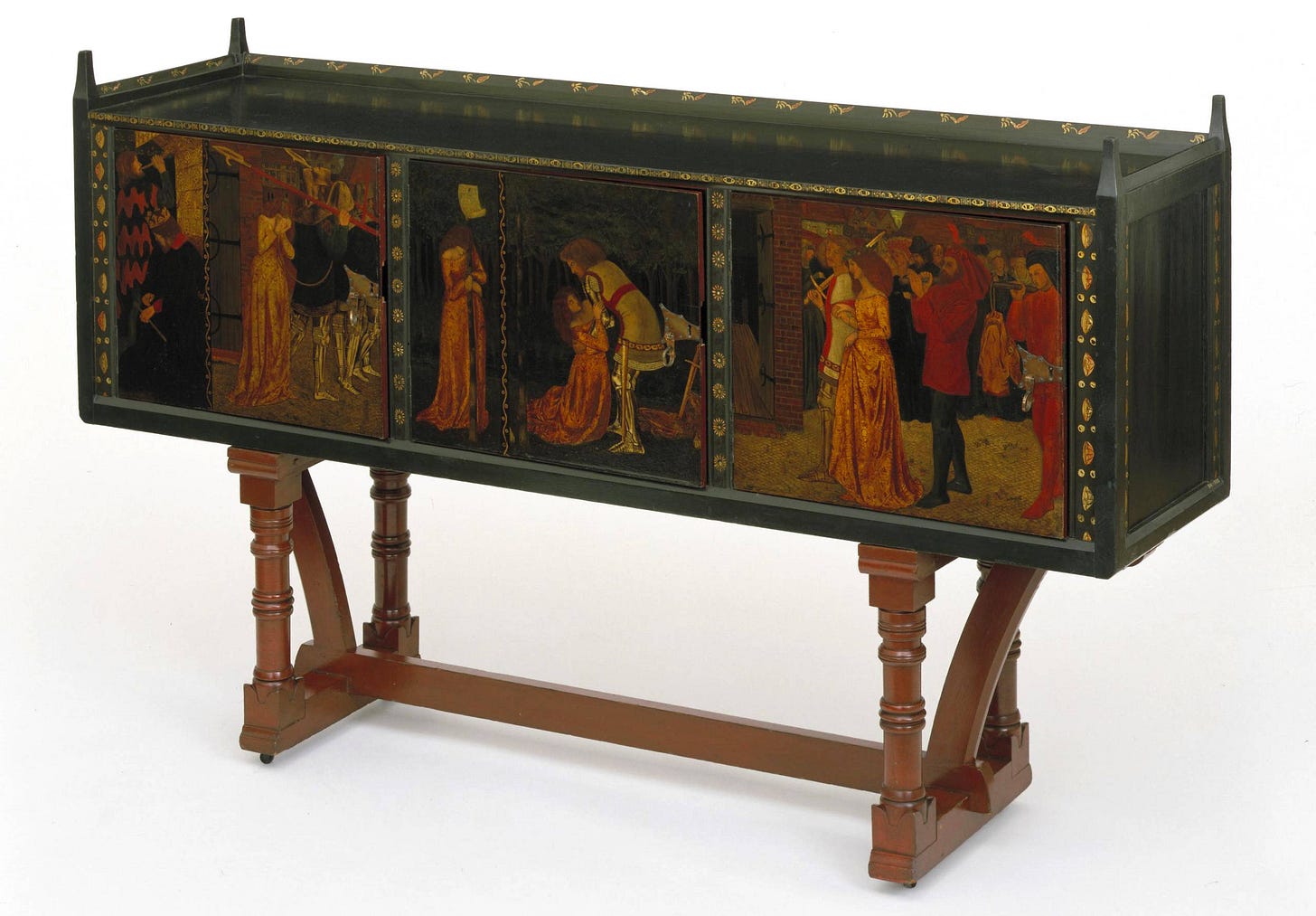
St George Cabinet, designed by Philip Webb, painted by William Morris, manufactured by Morris, Marshall, Faulkner & Co., 1861 – 2, England at the V&A
Are you finding yourself more drawn to the "imperfect" handmade object lately? I'd love to hear about the Morris pieces you're seeking, or if the digital boom of 2026 has made you look at your own home archives differently.
If you would like to receive posts like this by email then please sign up in the box below or follow me on Substack - The Modern Collector to join in the conversation.